
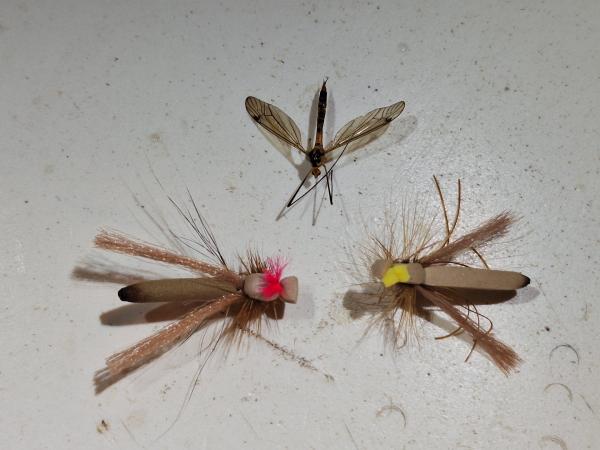
Many a fly tyer will no doubt have heard the phrase “There’s nothing new in fly tying these days…”, and this most certainly applies in the case of the Adult Crane Fly pattern presented here – like my other patterns, an amalgamation of ideas from a host of others before me … a little bit of research will show you that the pattern has been around for decades, each one having some useful feature to borrow!
While popular internationally (in various forms and sizes; probably the best known of the YouTube fly tyers being Davie McPhail, Barry Ord Clarke and Tim Cammisa – see list of video’s in references), locally however, the crane fly has received scant attention … to the best of my knowledge, only being referenced by Peter Brigg, and Alan Hobson (in this forum), and the only reference I can find in a South African publication is in Bill Hansford-Steele’s epic tome, “Fishing Flies for Africa”.
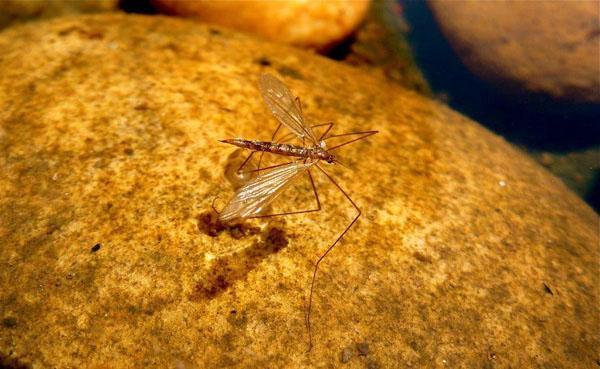
Crane Fly by Peter Brigg (2014)
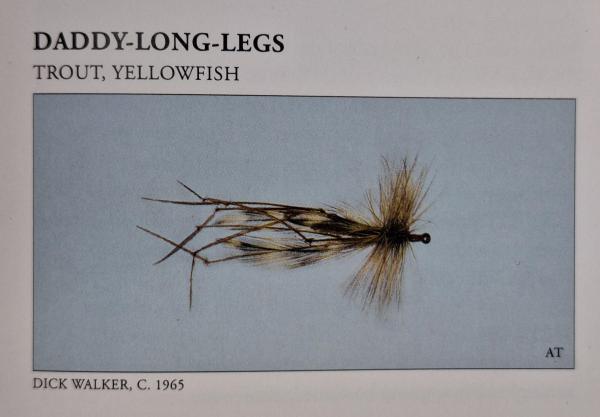
Crane Fly by Dick Walker (1965) from Hansford-Steele (2009)
I had some previous experience with a Daddy a good number of years back, when a U.K. visitor asked me to tie up some ‘Pearly Daddy’s” (see Sid Knight’s Pearly Daddy by Davie McPhail in list of references) to take back to the U.K., to fish at the well-known ‘Dever Springs’ exclusive trout fishery in Hampshire. My attention was recently drawn back to the pattern, after being informed that the dry fly version was fishing (very) well for Sterkfontein yellows, and of course, along with a request to tie some up … so here’s what I came up with.
Some research…
Adult crane flies can vary in size from a teeny 7mm to a large 50mm (1/4 inch to ~2 inches in ye olde English), with most common species falling in the 10-25mm range.
So, enter the fly tyers quandary: imitative or suggestive? (see Murray Pedder’s article in the latest TCFF in reference list). Skinny body, extended wings and trailing legs … the crane fly looks like it could be a fiddly beastie to recreate in small sizes. As an angler and fly tyer (and sometimes guide), I am looking to spend more time fishing than tying, so my tying is guided by the maxim of “Guide Flies”; i.e. flies that are not demanding of difficult‑to‑find materials, or complex tying procedures.
Enter another thought to complicate the pattern design: a crane fly is near-enough to other popular Sterkies food items – the flying ant / termite and hopper ... so how about a suggestive, easy-to-tie pattern that would do double duty as a crane-ant/termite/hopper combo?
With respect to materials, foam is popular for (larger) dry flies … both flat and cylinder foam makes for easy bodies. Segmentation, while not necessary, is easy to add (see the technique by Mak listed in references). For a version that sits lower in the surface film, Ultra/Suede Chenille (aka San Juan Chenille) can be used for the body (see Davie McPhail’s “simple Daddy’ in references).
Hackle tips are popular for the extended wings, and knotted pheasant tail fibres for the legs … however, both are subject to wear and tear. For a more durable fly, enter synthetic Antron or poly-yarn for wing material, and much harder wearing squirrel tail fibres or Daddy Long Legs (as the name suggests!) spanflex for the trailing legs.
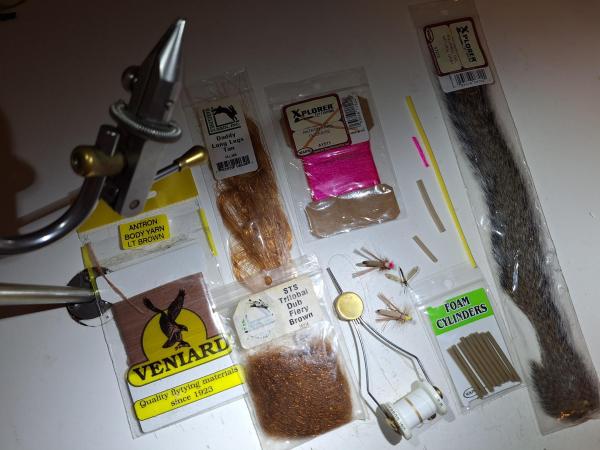
List of Materials :
- Hook : std‑shank #12 dry fly
- Thread : tan 6/0 (70 denier) or 8/0 (50 denier)
- Body : tan 1/8 inch (3mm) foam cylinder or 3mm wide strip of 2mm flat foam
- Trailing Legs : squirrel tail fibres or tan Daddy Long Legs spanflex
- Wings : tan Antron
- Thorax (case) : tan 3mm wide strip of 2mm flat foam
- Thorax (underbody1) : brown dry fly dubbing
- Thorax (underbody2) : brown dry fly hackle
- Indicator (optional) : bright coloured Antron yarn or foam strip.
Tying Steps.
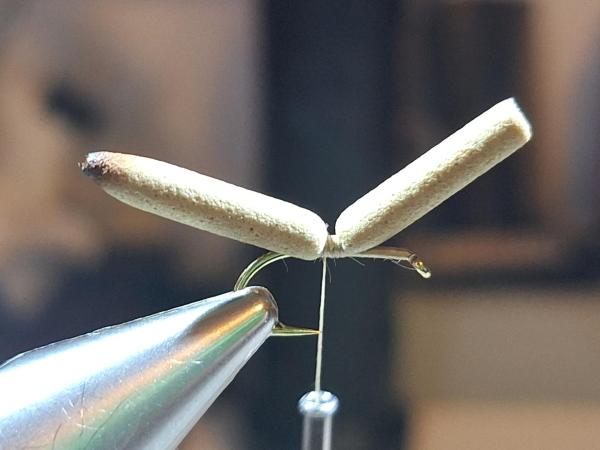
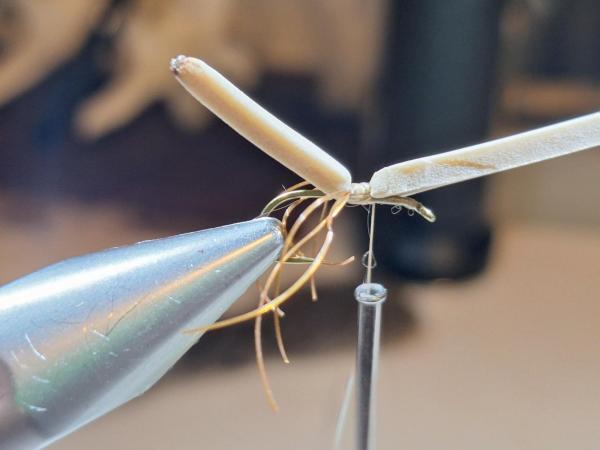
Step 1 – tie on the body (cylinder or flat foam) at above the hook point.
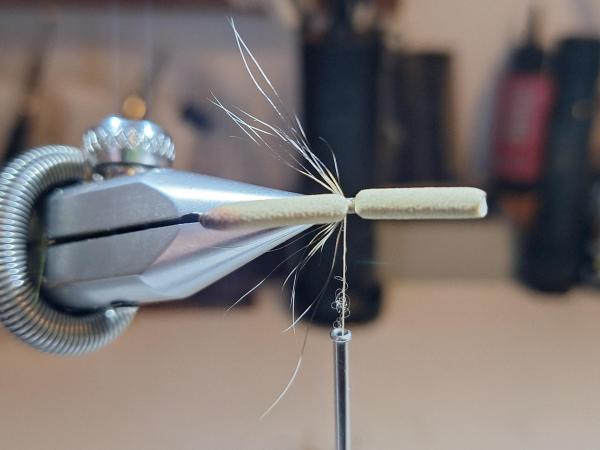

Step 2 – tie in the trailing legs…. your choice of squirrel tail or Spanflex.
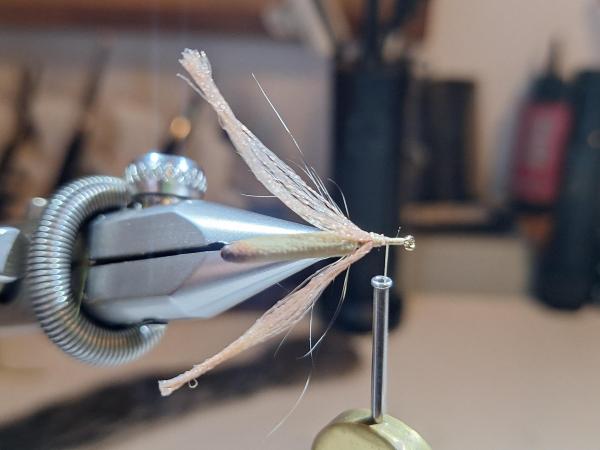
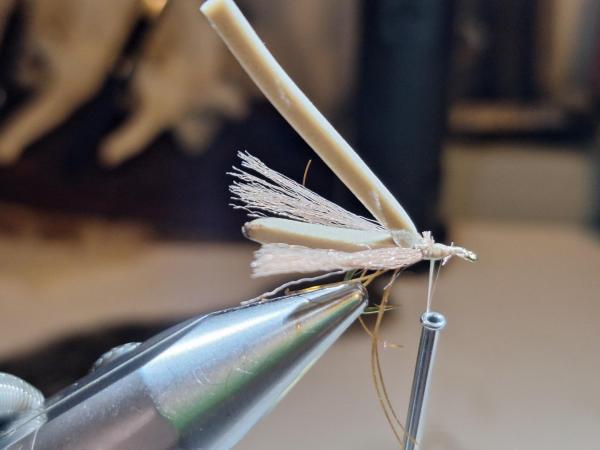
Step 3 – tie in the wings using either Antron or Poly-Yarn.
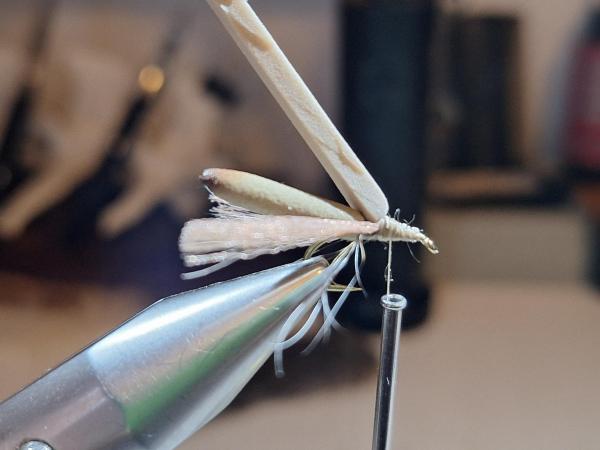
Step 3b – if using cylinder foam for the body, tie in the thorax case using a strip of tan flat foam.
From here on, the steps are the same for both cylinder and flat foam bodied flies …... so I am using the foam body fly ……
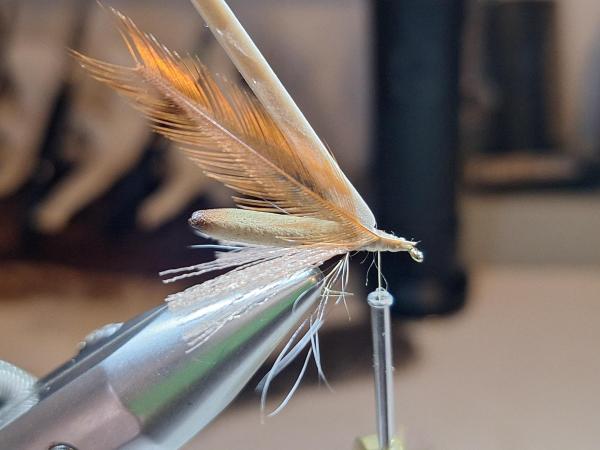
Step 4 – tie in feather for front hackle.
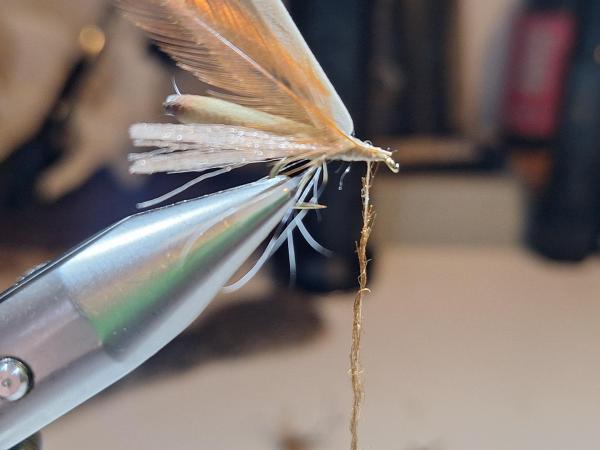
Step 5 – create a thin dubbing noodle.
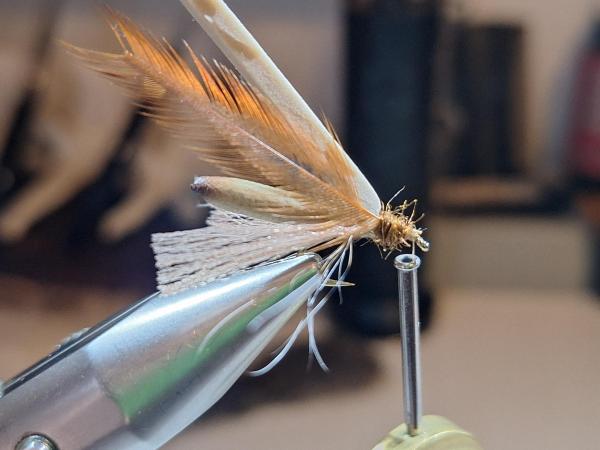
Step 6 – wrap dubbing forward to create the head.
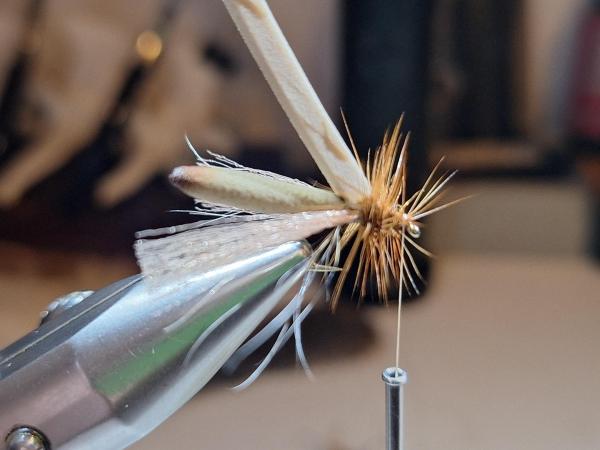
Step 7 – wrap hackle forward over dubbing.
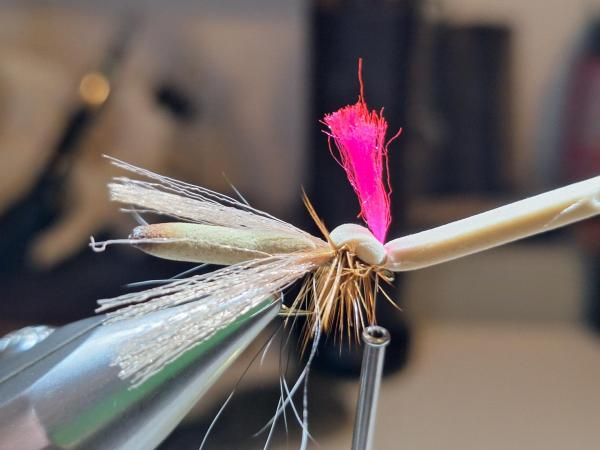
Step 8 – add optional sighter.
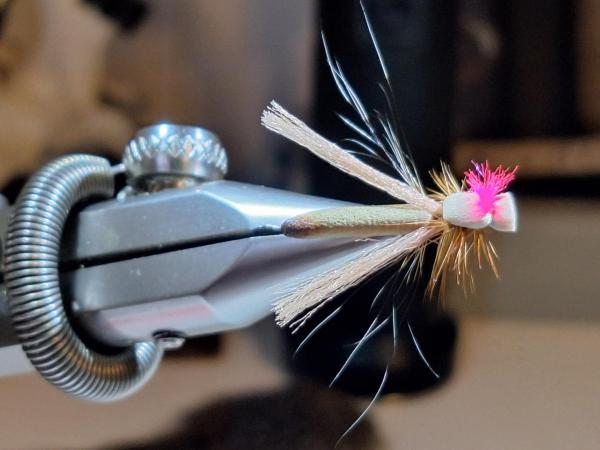
Step 9 – trim sighter and head to required length.
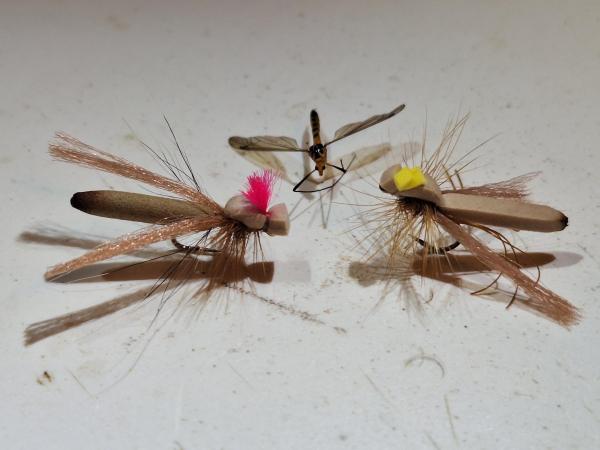
Finished flies:
– cylinder foam body with antron sighter.
– Flat foam body with foam strip sighter.

Rainbow trout with a Daddy.
(image from Fulling Mill)
Fishing the fly :
According to Hansford-Steele, August through September are the best months for Daddy-specific fishing in South Africa … although he says that he has caught fish “off season” in April with not a daddy in sight. I was assured that this fly got some serious attention from the yellows at Sterkfontein in mid-January, so I am confident that it will work pretty much any time as a general attractor dry (as mentioned, doing double/triple duty as a flying ant/termite and hopper).
Dick Walker, the originator of the pattern featured by Hansford‑Steele, advocated that the fly should be fished static, with no retrieve. I suspect however, that some movement every now and again will not go amiss, and even a retrieve. Fish being fish (if only they read the rules), some days they will prefer the static approach, while on others, they’ll prefer a subtle twitch or even a skating retrieve.
The fly being rather large, fish may try to drown the fly at first, so if you strike at the splashy commotion going on at your fly, and don’t connect, leave the fly in place and wait for the fish to return, grab the fly, and the line will tighten by itself as the fish takes off with its prey.
References :
Crane Fly :
Crane Fly by Peter Brigg :
Crane Fly by Alan Hobson :
Bill Hansford-Steele :
Suggestive or Imitative? The Fine Line Between Art and Effectiveness by Murray Peddar (with Marius Rousseau and Philip Meyer)
Tying a Foam Daddy Long Legs with Davie McPhail
Tying a Simple Daddy Long Legs by Davie McPhail
Tying Sid Knight's Pearly Daddy with Davie McPhail
Crane Fly Dry (Daddy Long Legs) by Tim Cammisa (tightlinevideo)
How to tie a Foam Daddy Long Legs from Fulling Mill
Fly Tying a Simple ( Threadless ) Segmented Body Daddy Long Leg by Mak
Tying the Foam Daddy Long Legs (Detached Body) by Davie McPhail
Fly Tying a Deer hair daddy long legs with Barry Ord Clarke
Fly tying a Detached bodied daddy long legs with Barry Ord Clarke
Tying the McPhail CDC Daddy by Davie McPhail


